

Training








How do you measuring the impact of corporate training, and justify its value? We look at the frameworks.

"Is our training making a difference?"
All learning and development (L&D) teams need to be able to answer this question, especially at budget review time. And when organizations in the US are spending more than $100 billion a year on training, it's not surprising that businesses want reassurances that they're getting bang for their buck.
But measuring the effectiveness of corporate training programs isn't easy. Important trends like lower employee turnover, stronger sales, happier customers, and fewer costly mistakes can take months, possibly even years, to show up on the bottom line.
Unfortunately, that's not much help when L&D teams are defending this year's budget.
What they need is a better way to prove their training is working today, while continuing to track its longer-term impact and ROI. Let's explore how that's possible with AI roleplay and immersive learning.
Measuring the impact of corporate training isn't a new field. The Kirkpatrick Model, created by Dr Donald Kirkpatrick, has provided a framework for evaluating training effectiveness since the 1950s.
Dr Kirkpatrick's work was then expanded by HR specialist Jack Phillips in the 1970s to include an added layer of evaluation around return on investment to measure the financial viability of training programs.
Both of these frameworks are still widely used today, many decades later. But they are only frameworks — they suggest what to measure and provide some guidance on the ways to do it.
However, it's still up to organizations to do the legwork of collecting the necessary data and analyzing performance, which is where things start to get tricky.
Kirkpatrick and Phillips both recognize the importance of distinguishing between what people learn during training and whether they go on to apply that learning in the workplace.
In theory, this should give L&D teams a more complete picture of whether training is actually changing people's behavior. In practice, not all organizations are collecting the information that tells them what they need to know.
For example, many L&D teams rely on metrics like completion rates and learner satisfaction scores to gauge whether their training has been a success.

A Watershed survey found that nearly a third of organizations still use satisfaction levels as the main measure of whether training is working, whereas just 13% prioritize job performance improvements and a mere 6% focus on ROI.
Now, it's good to know staff are enjoying their training! But it doesn't tell you whether they're retaining what they've learned or becoming better at their jobs as a result.
This makes it very difficult to assess the impact and ROI of your training; a challenge that perhaps explains why 15% of organizations aren't measuring their training effectiveness at all.
A whopping 94% of organizations believe it's possible to prove the impact of learning in their workplace (including us!) and 73% agree it's vital to set aside enough budget to do it.
So far, so good. But what's preventing L&D teams from measuring corporate training effectiveness?
According to research from the Association for Talent Development (ATD), the biggest hurdle is a lack of resources, such as staffing and time. This is a major issue for more than half (51%) of organizations.
Another big problem is data — 43% say they do not have access to the information they need to perform proper evaluations, while 36% say their learning management system doesn't collect the right data in the first place.
Ultimately, 38% say it is simply too hard to isolate the impact of training on their business's results. Not enough staff, not enough data, not enough time.

Fortunately, there are solutions to these problems, so that training ROI can be tracked more accurately and demonstrated more clearly, both in the short term and over the long term.
As we've talked about, when it comes to effective training, learning is only part of the story — you also need to know whether people can put those skills into practice.
Research increasingly shows that immersive learning is one of the best ways to do this. It uses realistic, interactive scenarios to let people practice their conversational skills and make decisions in a safe environment before applying them on the job.
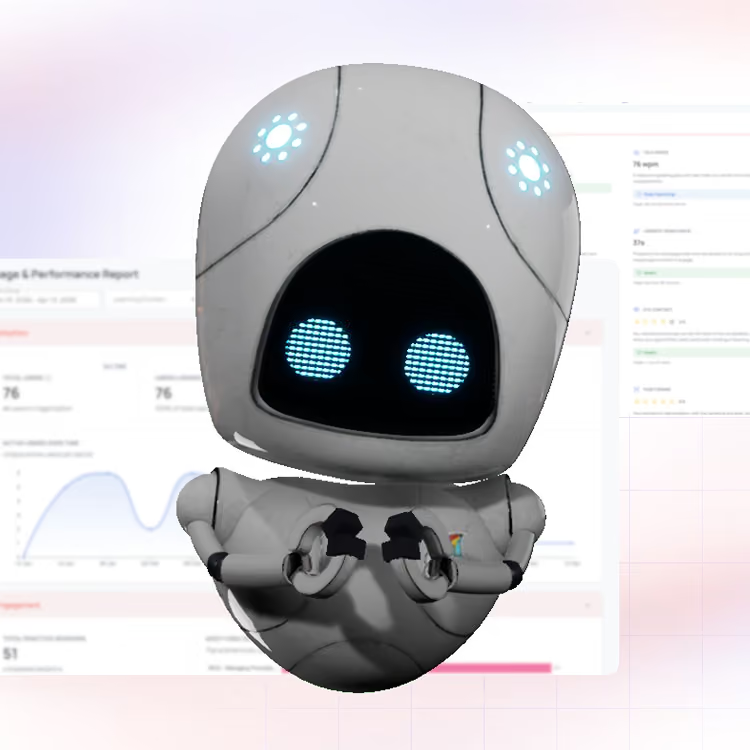
Our Immersive Training Platform takes this approach a step further with AI roleplay, using innovative digital humans to simulate real-world interactions while capturing detailed analytics on how people perform during the training itself.
And that data gets pretty granular! It includes scores against specific competencies, such as sales discovery skills, objection handling, or product knowledge, with L&D teams able to set their own custom scenarios and criteria.
You're also able to track things like speaking speed, filler words, talk-to-listen ratios, and how long someone speaks without interruption — all benchmarked against predefined targets.
It's not just about what people say either. Our Immersive Training Platform can score body language, facial expressions, eye contact, tone of voice, and conversation flow, as well as softer skills such as empathy, adaptability, and emotional mirroring.
These measures are captured during each session, so teams can start to see where employees are improving immediately and where they may still need further support.
And because our platform is browser-based, people can practice wherever and whenever they need to, without relying on a manager, colleagues, or expensive equipment to get started. That makes consistent training much easier to scale.
These features all help with several of the problems L&D teams say they are facing: limited staff and time, patchy data, and systems that don't capture enough useful information.
Crucially, our platform enables you to integrate user training session data into your own existing BI platforms, analytics tools, or custom dashboards.
That means you can align your training data with the numbers that take longer to emerge, such as win rates, ramp times, and quota attainment.
You can also set Endorsements: an easy-to-track achievement that gives visibility over which learners have reached or exceeded a specific score, signalling that they’re proficient in a certain scenario or skill.
Simply set a baseline before training starts, and over time you can compare the results with the cost of the training to calculate your training ROI.
It won't make every training outcome clear overnight. But it does mean that next time someone asks, "Is our training working?" in a budget review, you'll have something far more tangible than completion or satisfaction scores to show.